
The Tale of Cymbeline
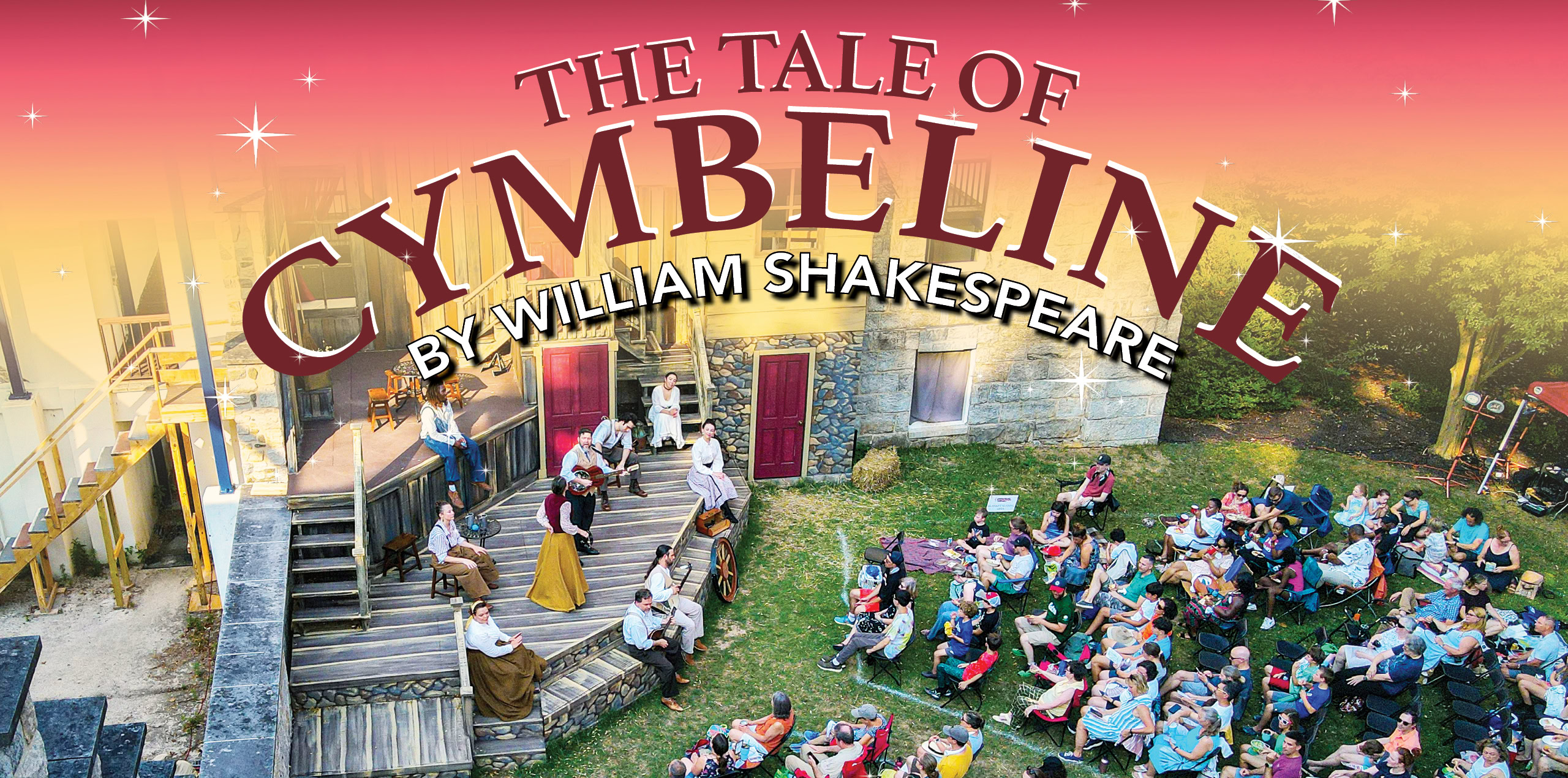
JOIN US AT OUR SUMMER HOME IN ELLICOTT CITY!
JUNE 12 – JULY 19
Forbidden love, mistaken identities, banishment, and a magic potion—The Tale of Cymbeline follows Princess Imogen of Britain on a quest for reconciled love. In her ascension from despair to heroism, she brings redemption to a kingdom ruled by chaos. Rarely performed, this mesmerizing play showcases Shakespeare’s mastery of storytelling, characters, and poetry.
AS ALWAYS, KIDS GET IN FREE!*
*Up to two free youth tickets per paying adult. Subject to availability.
Free Shakespeare for kids is made possible by
The John E. and Sue M. Jackson Charitable Trust

WATCH THE ALL-NEW TRAILER
Synopsis
Once Upon A Time..
Cymbeline, King of Britain (when Augustus Caesar was Emperor of Rome), has a daughter, Imogen, and two sons who were stolen in infancy. Cymbeline's second wife has a son, Cloten, whom Cymbeline wants Imogen to marry; but she has secretly married a commoner, Posthumus Leonatus.
The Wager
Cymbeline banishes Posthumus to Rome, where he meets Iachimo, who wagers with him that he can seduce Imogen. Arriving in Britain, Iachimo realises that she is incorruptible, but, hiding in her bedroom, obtains false evidence which convinces Posthumus that he has won the wager.
The Disguise
Posthumus orders his servant Pisanio to kill Imogen at Milford Haven, but instead Pisanio advises her to disguise herself as Fidele, a page. In Wales, she meets her brothers, who were stolen twenty years before by the banished nobleman Belarius. Cloten pursues Imogen to Wales in Posthumus' clothes, determined to take her and kill Posthumus. Instead, Cloten is killed by one of Imogen's brothers, and his decapitated body is laid beside Imogen, who has taken a potion that makes her appear dead.
Invasion
When she revives, Imogen/Fidele joins the Roman army, which is invading Britain as a result of Cymbeline's failure to pay tribute to Rome. Posthumus and the stolen princes are instrumental in defeating the Roman army. A final scene of explanations leads to private and public reconciliation.
Lovingly adapted from The Royal Shakespeare Company
About Shakespeare’s Cymbeline
By Barbara Mowat and Paul Werstine
Editors of the Folger Shakespeare Library Editions
Cymbeline tells the story of an ancient British king and his three children. The king, Cymbeline, is mentioned in chronicles in Shakespeare’s day, and may be historical or may be legendary. The chronicles say that he ruled at the time of Augustus Caesar, was brought up in Caesar’s court, and had a peaceful reign. His children—although the two sons, Guiderius and Arviragus, also appear in the chronicles—are presented in the play as if they have stepped in from romance or fairy tales. And Cymbeline himself, with his marriage to a beautiful but wicked queen and his almost miraculous victory in his war against Rome, also partakes far more of romance than of history.
Much of the play focuses on the story of the king’s daughter, Imogen, whose secret marriage to a gentleman named Posthumus Leonatus triggers a great deal of the play’s action. Her father, outraged at the marriage, banishes Posthumus, who is then maneuvered into making a foolish wager on Imogen’s chastity. The story that follows of villainous slander, homicidal jealousy, cross-gender disguise, a deathlike trance, the appearance of Jupiter in a vision, and final repentance, forgiveness, and reunion is the stuff of the popular fiction of the time, as well as of popular drama of an earlier period. The trials of Imogen, however, are also larger than life, reminding one of the sufferings of mythological heroines who anger powerful gods.
The story of Cymbeline’s two sons, which intersects with that of Imogen, is even more deliberately fictional. As the play tells it, Guiderius and Arviragus were kidnapped in infancy and raised in a cave in the Welsh mountains. (The play acknowledges the incredibleness of this part of the plot by having a gentleman say to a doubter: “Howsoe’er ’tis strange, / Or that the negligence may well be laughed at, / Yet is it true, sir” [1.1.75–77]). Knowing nothing of their heritage and remembering no life beyond their mountain cave and its environs, the young men yearn for adventure. In the course of the play, they rescue a starving young man (their sister Imogen in disguise); they kill and decapitate Cymbeline’s stepson; and they go into battle against the Roman army and prove almost superhumanly valiant.
The fairy-tale-like stories of Imogen and of her brothers play against the somewhat more realistic story of King Cymbeline as he takes on a Roman invasion rather than pay the tribute agreed to by his ancestors. References to such personages as Augustus Caesar and Julius Caesar and his conquest of Britain appear to ground Cymbeline’s story in history. But Cymbeline too is a familiar romance figure—a father who loses his children and after long years miraculously finds them; a king who, through what seems supernatural intervention, defeats an invading army and then grants pardon to all.
Shakespeare uses the long-ago-and-far-away fantasy quality of the stories dramatized in Cymbeline as the ground against which he displays unusually powerful human emotions. The play tells of love and loss, of jealousy and fury, of the joy of finding and the near-delirium of reuniting after heartrending separation; and the language in which the emotions accompanying these human states are expressed has never been more potent. The audience is seldom allowed to forget that the action is fictional; at the same time, the characters’ ordeals and triumphs and their responses to those moments carry a tremendous charge. The resulting drama, while reminding us at many times of stories and situations explored in earlier Shakespearean plays, has a quality that links it to his other late work—especially The Winter’s Tale and The Tempest—as a dramatization of improbable story lifted, through its characters and its language, into a realm that is nearly mythic in scope.
Lovingly borrowed from Folger Shakespeare Library
CAST
Imogen – Fabiolla da Silva
Posthumus/Cloten – Joshua Williams*
Cymbeline/Storyteller – Samuel Richie*
Iachimo/Storyteller – Lizzi Albert*
Pisanio/Storyteller – Abel Haddish
Belaria/Queen – Ali Haas
Guiderius/William – Lloyd Marcus*
Arviragus/Adrian – Luke Douglas
Caius Lucius/Helen/ Cornelius/Storyteller – Elana Michelle*
UNDERSTUDY
Brooke Donald
ARTISTIC AND CREATIVE TEAM
Director - Ben Lambert
Production Manager - Lauren Engler*
Stage Manager - Colin Maher
Swing Stage Manager - Lauren Engler*
Technical Director, Set/Lighting Designer - Dan O'Brien*
Costume Designer/Wardrobe - Hannah Brill
Music Director - Grace Srinivasan*
Sound Designer - Chris Lane
Props Artisan - Mason Dennis
Production Associate - Dawn Thomas Reidy*
Fight Director - Jenny Male
Intimacy Consultant - Mel Gabel
Dialect/Text/Vocal Coach - Emily Erikson*
Dramaturg - Abraham Stoll
Assistant Stage Manager - Ilana Mongilio
Assistant Technical Director - Chester Stacy*
Production Assistant - Audrey Russell
Technical Manager - Cameron Luther
Production Intern - Ryan Macdonald
Senior House Manager - Pamela Forton*
* CSC Company Member
Chesapeake Shakespeare Company In-The-Ruins Presents The Tale Of Cymbeline
Chesapeake Shakespeare Company Announces New Season: Love, Transformation, Classics
REVIEWS
LISTEN NOW - Rousuck Reviews: ‘The Tale of Cymbeline’ at Chesapeake Shakespeare Co.
"The perfect summer family outing. A fantastical storyline...provides moments for both humor and beautifully portrayed, realistic emotions….you'll love the experience that Chesapeake Shakespeare has created. Pack yourself a picnic and head to Ellicott City for a truly unique summer show!" - Alysa Cripe, MD Theatre Guide
"An excellent cast, combined with a unique outdoor setting, is one of the best ways to enjoy this roller-coaster of a play...This production makes it easy to understand why the CSC has hosted Maryland’s longest-running outdoor Shakespeare event here for more than 20 years." - Morgan Feddes Satre, DC Theater Arts
"⭐⭐⭐⭐⭐ An absolutely charming, engaging, and all-in-all fantastically entertaining production masterfully directed by Ben Lambert...that no one should miss." - Erin Tarpley, Theatre Bloom
FAMILY FUNDAY
Sundays are our Family Fun Days, with pre-show activities for all ages including crafts and storytime, beginning at 5:30pm. Picnics welcome! Use our folding chairs or bring your blanket.
PERFORMANCES
Take a Virtual Tour of Our Summer Home
Contact The Box Office:
By Phone: 410-244-8570
By Email: boxoffice@chesapeakeshakespeare.com
CSC Box Office is open for business!
Tues - Fri from 10am - 4pm